Seville or Córdoba is the question we hear most from guests who have a week on the Costa del Sol and one day to spare for a big city. Both sit in the Guadalquivir valley, both were capitals of Al-Andalus at different moments, and both can be done as a day trip from Málaga or Marbella with a private driver. They are not interchangeable, though, and the better choice depends on where you are staying, the month and how much walking your group enjoys.
Below we compare the two days as they really unfold: hours in the car, what the visit covers, how the summer heat changes things and who tends to come back happier from each. We also explain why we talk people out of trying to see both cities between breakfast and dinner, however tempting it looks on the map of Andalusia.
The drive: closer than you think, or further
From Málaga, Córdoba is 1 h 45 away (about 160 km) and Seville 2 h 15 (about 210 km). That is half an hour less in each direction, a full hour over the day, in Córdoba's favour. From Marbella the picture changes: both cities come out at about 2 h 30 each way, Seville at roughly 210 km and Córdoba at roughly 220 km. If you are staying in Marbella or Puerto Banús, distance does not decide anything.
The total length of each day reflects this. Our Córdoba tour runs to about 9 hours and the Seville one to about 10 h 30, counted from your door and back. Starting from Málaga, Córdoba means three and a half hours on the road and five and a half in the city; Seville means four and a half on the road and six in the city. From Marbella, five hours of driving go into either.
A day in Seville: Alcázar, Cathedral and room to wander
The heart of the Seville day is some three and a half hours inside the two great monuments, on your own or with a licensed guide we can arrange on request. The Royal Alcázar is a working palace, still used by the Spanish royal family: tiled halls, the Courtyard of the Maidens and gardens with peacocks and orange trees. Across the square, the Cathedral is the biggest Gothic cathedral anywhere, with the tomb of Columbus and the Giralda, the former minaret you climb by ramps rather than stairs.
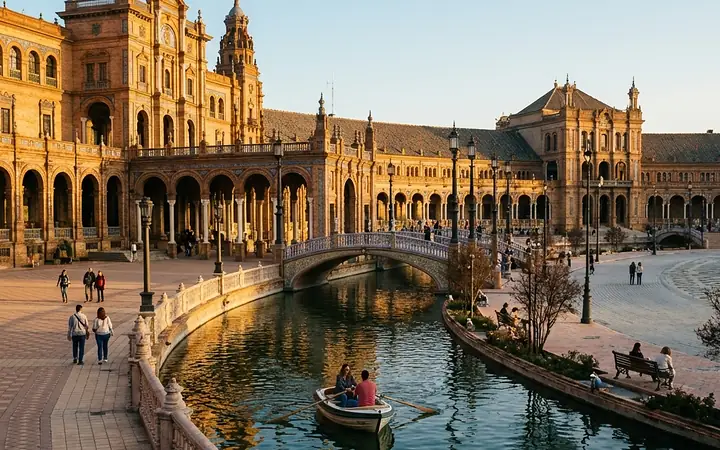
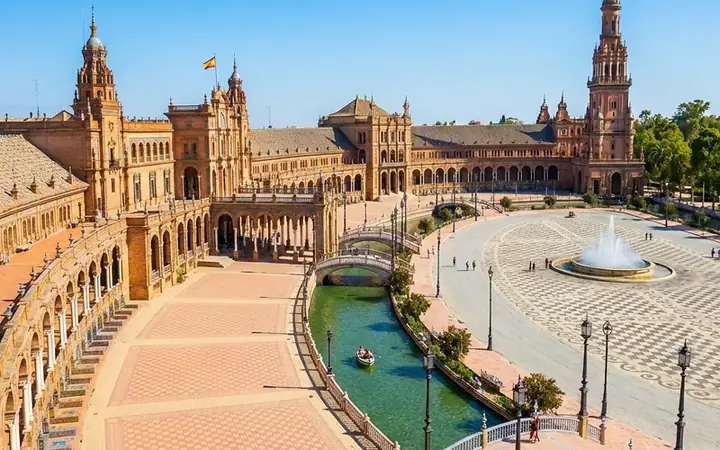
After the monuments, Seville still has plenty to give: the lanes of the Santa Cruz quarter, a tapas lunch standing at a bar, and the sweep of the Plaza de España, where the driver can stop before the road home. You will not see it all, and the day works best if you accept that and choose.
In short
- From Málaga, Córdoba is half an hour closer each way; from Marbella both are about 2 h 30.
- Seville is the longer day, about 10 h 30, with 3 h 30 in the Alcázar and Cathedral.
- Córdoba is about 9 h, with 2 h 30 for the Mezquita plus the Judería, all on foot.
- In July and August both are very hot; Córdoba is the easier of the two.
- Doing both in one day leaves no real time in either.
A day in Córdoba: the Mezquita and the Judería
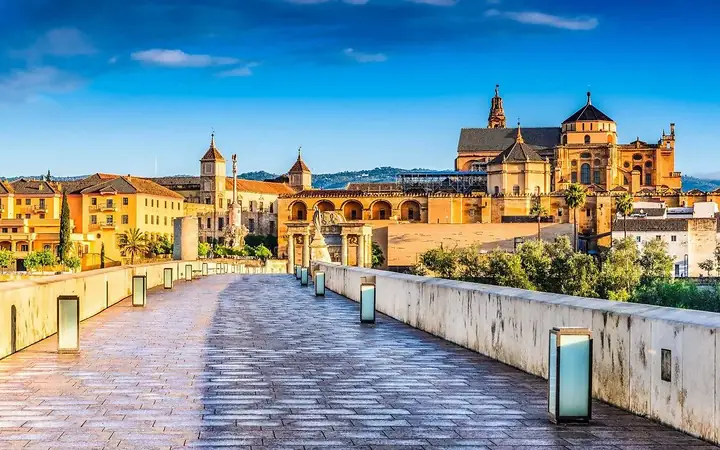
Córdoba's visit takes roughly 2 h 30 and is more concentrated. The Mezquita-Catedral is unlike any other building in Europe: a forest of columns and red-and-white double arches from the Umayyad mosque, a mihrab covered in Byzantine mosaic, and a Renaissance cathedral nave raised in the middle of it all. Some hours are set aside for worship, so the visiting time is confirmed when you book.
From the Mezquita's door you step straight into the Judería, the old Jewish quarter: the small medieval synagogue, whitewashed alleys, the Calleja de las Flores and glimpses of flower-filled patios. Everything is within a few hundred metres, and the Roman Bridge is two minutes from the Patio de los Naranjos. Lunch here means salmorejo, fried aubergines with cane honey and oxtail. Córdoba feels like a town rather than a metropolis, and by mid-afternoon most visitors feel they have understood it.
Summer heat: the factor nobody plans for
Both cities lie low in the Guadalquivir valley, well inland, and they are among the hottest places in Europe in July and August. Afternoon temperatures above 40 °C are not unusual in either, and the coast's sea breeze does not reach them. It is no reason to cancel, only to plan differently: set off at first light, keep the monuments for the morning, eat somewhere with air conditioning and be back in the car by mid-afternoon.
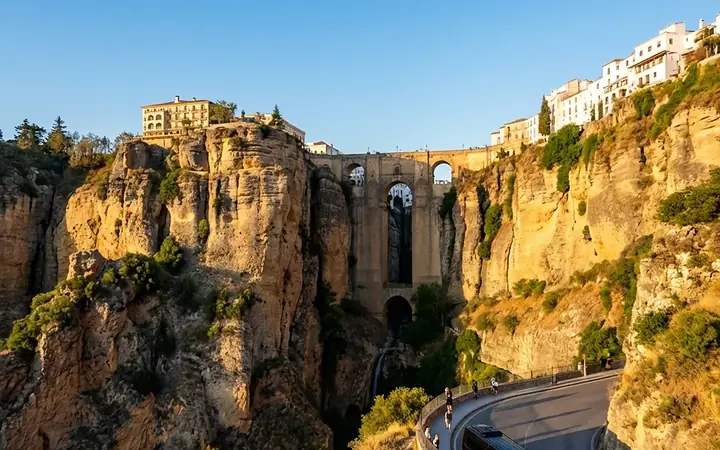
Of the two, Córdoba copes better with a hot day. The Mezquita is dim and cool, the Judería's lanes are narrow enough to stay in shade and distances are short. Seville's visit has more open ground and its day is an hour and a half longer. From October to May the choice is free; in high summer we lean towards Córdoba, or towards Ronda and the mountains instead.
Which city suits whom
There is no wrong answer, but there are patterns in what guests tell us afterwards.
- Choose Seville if you want big-city atmosphere, royal palaces and gardens, and you are happy with a long day.
- Choose Córdoba if you are staying in or near Málaga, travelling with children or older relatives, visiting in summer, or simply prefer one extraordinary building and a compact old quarter to a list of sights.
- Special dates: Córdoba's patios open for their festival in May; Seville during Holy Week or the April Fair is spectacular but crowded, with streets closed.
Why not both in one day?
Because the numbers do not work. The two visits alone add up to six hours: three and a half in Seville and two and a half in Córdoba. Add 2 h 15 from Málaga to Seville and 1 h 45 from Córdoba back to Málaga, and you are at ten hours before counting the road that links the two cities, lunch, or a single unplanned stop. From Marbella it is worse.
You would see two cathedrals through a car window and remember neither. If both cities matter to you, give each its own day, with a beach day in between. It costs more than one long day, and it is the only version that does either place justice.
Plan your private tour
No prepayment. You pay on the day, by card or cash. Free cancellation up to 48 h before.